

OUR RECORDS
We are actively involved in conserving, restoring, improving and protecting Pensychnant's
natural environment and biodiversity. We aim to observe, record and further understand the diverse species found within the special ecosystem of our Nature Reserve.
Our aim is to build a list of all the wildlife that shares Pensychnant with us... but in the process help people to appreciate and understand our wildlife, be it plant, insect, fungus, bird, or whatever.
Cofnod is our Local Environmental Records Centre and the home of wildlife data for North Wales. We find that their Online Recording System (ORS) is an easy way for us to enter and store our wildlife data. Please add to this when you can by recording your observations of wildlife at Pensychnant using the link below.
As of the beginning of 2025 Cofnod said we had 29,916 environmental records
- can you help increase this?
These records were made up of 1,719 different species - yours might just be a new one!
Featured Wildlife

Clifden Nonpareil
(Catocala fraxini)
On 6th September 2020 Julian trapped this impressive moth - the first record of this species for North Wales. The North Wales Pioneer reported this at the time and Julian is quoted - “This is an impressive moth, indeed its name is French for ‘without equal or unsurpassed’. It has caused quite a stir amongst the local naturalists, with many coming to see it at Pensychnant. It is an immigrant, probably from Eastern Europe. It has never before been recorded in North Wales.”

Weaver's Wave
(Idea contiguaria)
Ashworth's Rustic
(Xestia ashworthii)
The heaths, rich in invertebrates, are the best-known location to see two rare moths, Ashworth’s Rustic and Weaver’s Wave, which occur here in the mountains of North Wales and nowhere else in the world. In Victorian times there was tourist trade in Penmaenmawr based on collectors travelling to catch (and later pin) these moths. Now people will travel from all over Britain to see them when they fly in July.

Black Poplar
(Populus nigra)
THE RAREST TREE
There are estimated to be about 7000 Black Poplars in Britain, making it one of UK's rarest native tree species. Pensychnant has three - a massive male planted in 1870's and two females cloned from a tree in Dyserth in about 2010. In May 2025 urged on by Richard Brunstrom, we hand pollinated one of the female trees with pollen from a tree in Bodlondeb. By the end of May, the fluffy seeds for which Black Poplars are renowned had developed and were harvested. Six days later the first seedlings germinated. Black Poplars are rare, but Black Poplar seedlings are vanishingly rare. Seeds must be rare because female trees are rare: there are only 5 known females in North Wales. And even if seed devoloped, the chance of seedling establishment is minimal because the seeds have tiny cotyledons, so cannot cope with competition. These may be the first Black Poplar seedlings in North Wales for hundreds of years. In only 150 years they'll be big.

Splitgill
(Schizophyllum commune)
Splitgill may be one of the most widespread fungi in the World, occurring on every continent except Antarctica. It is a dead-wood rotter, but seems to have taken a liking to plastic-wrapped silage bales, where it causes white-rot in the hay; and it has taken a liking to Pensychnant's big bale haylage. It is not especially well-recorded in North Wales, but one study recorded it on 50% of big-bales in Ireland. It is probably ubiquitous here too. Some studies suggest that it can biodegrade black silage wrap. Certainly, at Pensychnant, it prefers wrapped to unwrapped bales. It is easily recognized by its longitudinally split gills and felty caps. It is tough and persistent in winter. Go out and find it! Every similar bracket emerging from wrapped silage is likely to be Splitgill. Fungi are neither plant nor animal, nor a single group in themselves. There are four phyla of fungi based on their reproductive systems. We are familiar with the human system with two alleles (X and y) at one locus on the chromosomes. Splitgill has more than 300 different alleles at one locus and 90 at a second locus on a separate chromosome. Mathematically there are more than 28,000 possible combinations; or 28,000 different sexes. Each individual is compatible with any of the 28,000 except its own genotype, giving 99.98% outbreeding (Compared to 50% in humans). The enormous number of sexes in fungi encourages non-sibling mating, which ensures genetic diversity in the population. This seems to have worked quite well in the widely distributed Splitgill.


Lesser Horseshoe Bat
(Rhinolophus hipposideros)
MOTHER REUNITING WITH PUP Research by a team of students from Chester University in 2025 has provided this privileged glimpse into the lives of Pensychnant's Lesser Horseshoe Bats. Here (fast forward to 1 minute), a female returns to the roost and rejoins its pup. The Chester Uni students have been studying Lesser Horseshoe Bats at 10 maternity roosts in North Wales using cameras and ultrasound microphones, and collecting droppings to measure the levels of stress-related hormones, cortisol and corticosterone, and relating this to levels of noise and light pollution. First results show that the bats are most disturbed by unpredictable noise, and are more likely to react when pups are present. The research will continue in 2026. I look forward to proving that Pensychnant's bats are the most chilled of all bats in North Wales.
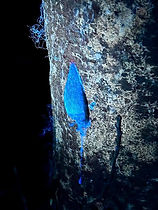
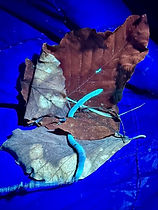
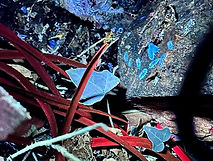
Glow-in-the-dark Wildlife
Who would know that worms, woodlice and other familiar plants and animals, fungi and lichens, bioflouresce in psychadelic colours under UV torchlight? The Green Cellar Slug (Limacus maculatus) glows blue but turns acrid green when touched. Why? Shining this UV torch opened up a whole new, unimagined world of wildlife.
Thanks Dani Boom Robertson-Phillips for coming with her torch and thanks to Brenda Rigby for the photos
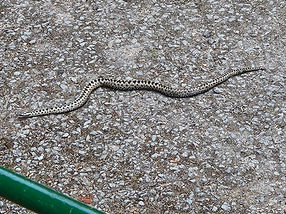
ADDER
26th April 2026
This male Adder, spotted by Susan Loose on the drive at Pensychnant, is one of the most exciting finds recently.
30 years ago, adders could be taken for granted at Pensychnant and on Conwy Mountain, but they haven't been recorded here since 2001.

STOAT
25th April 2026
Seen chasing rabbits by Eirlys Edwards-Behi.

YELLOW FLOWER CRAB SPIDER
8th May 2026
This Flower Crab Spider, Misumena vatia, is perfectly camouflaged in a Welsh Poppy in Pensychnant's Garden.
Different spiders have different ways of catching prey: Some trap their victims in cobwebs; Wolf Spiders and others chase after their prey; and Crab Spiders wait in ambush, catching any unsuspecting creatures which pass too close with their strong, massive front legs. The Flower Crab Spider's camouflage is deadly.

TAWNY OWLET
25th May

PIED FLYCATCHER
25th May
Male and female feeding young at the nest.

HUMMINGBIRD HAWKMOTH
26th May 2026

SCARLET TIGER
Seen on 23rd June There are some moths which every moth-er wants to see. Scarlet Tiger, with its dramatic red underwings is one of them and for a few years I have been slightly jealous of people who had them in their gardens.